

Kentucky does not issue a statewide license for residential general contractors or home builders. Anyone here can call themselves a builder. That makes the written contract, and a handful of things you can verify yourself in about twenty minutes, the only real protection you have before you sign.
This is not the answer most people expect. “Are you licensed and insured” is the standard question, and in Kentucky the first half of it does not mean what you think it means.
What follows is what to ask instead, what to check, and the specific deadlines in Kentucky law that decide whether a problem later is an inconvenience or a lien on your house. It is general information rather than legal advice, and anything with real money attached is worth putting in front of an attorney.
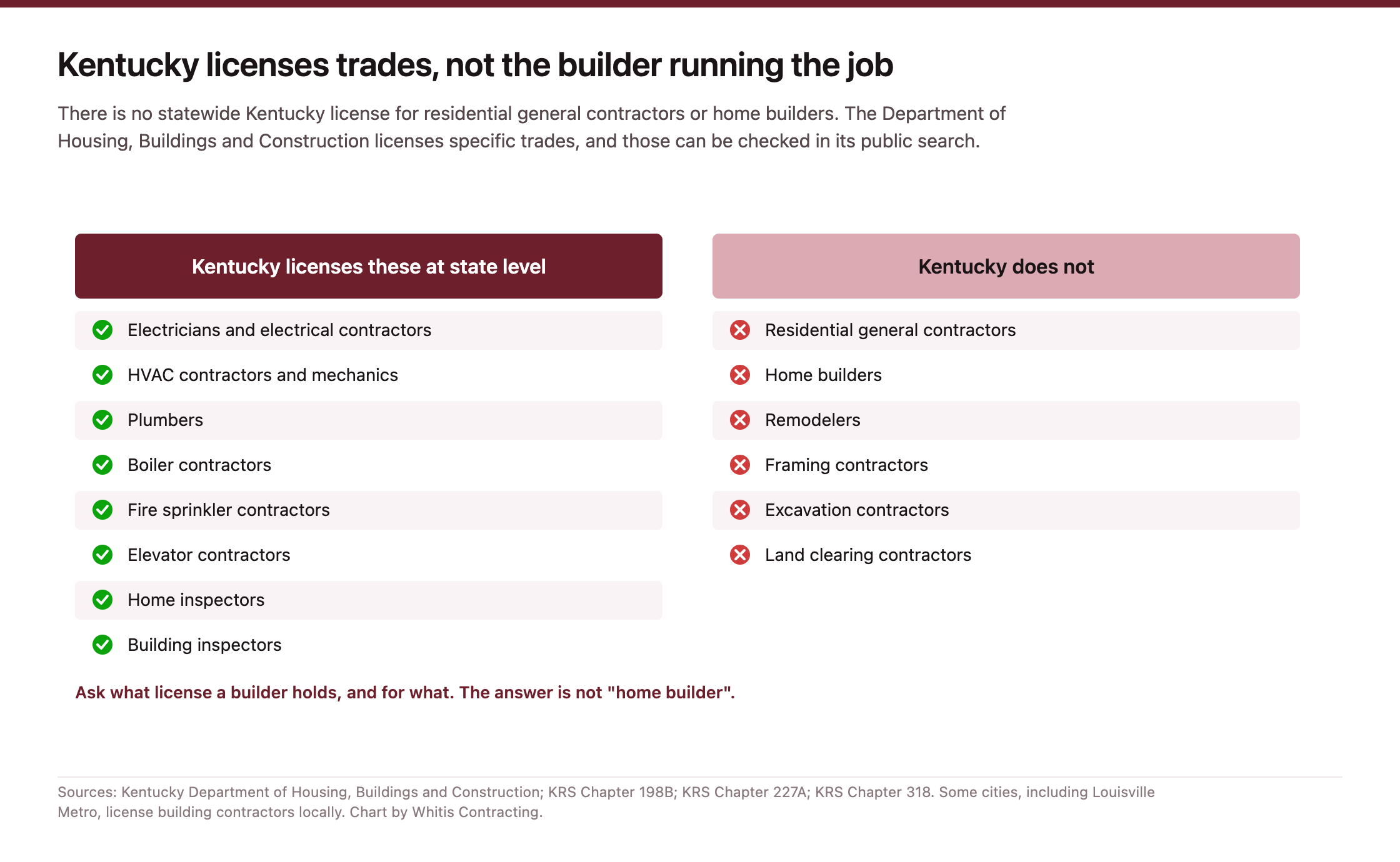
Kentucky does not license home builders
The Kentucky Department of Housing, Buildings and Construction describes its own licensing role as covering “plumbers, electricians, boiler contractors, sprinkler and/or fire alarm contractors and building inspectors.” General contractors and home builders are not on that list, and KRS Chapter 198B, the chapter that governs the Kentucky Building Code, contains no section licensing them.
Kentucky licenses trades, not the person running the job. At state level that means electrical contractors, master electricians and electricians under KRS Chapter 227A, HVAC contractors and mechanics under KRS 198B.650 to 198B.689, plumbers under KRS Chapter 318, boiler contractors under KRS Chapter 236, fire protection sprinkler contractors under KRS 198B.560, elevator contractors, home inspectors under KRS 198B.712, and building inspectors under KRS 198B.090.
Those licenses are real and checkable. The Department of Housing, Buildings and Construction runs a public license search covering building inspector, electrical, manufactured housing, HVAC, plumbing and fire licenses. Some of them carry insurance minimums written into the statute: KRS 227A.060 requires an applicant for an electrical contractor license to carry “a general liability insurance policy of not less than one million dollars ($1,000,000),” and KRS 198B.712 requires licensed home inspectors to carry general liability coverage of at least $250,000.
Local rules vary and are worth checking separately. Louisville Metro does license building contractors, under categories it calls Building Type A and Building Type B. Lexington-Fayette refers to a general contractor registration with its Building Inspection division. Garrard County runs a Level 1 building inspection program approved with the state department, and publishes no county contractor license of its own.
So when a builder tells you they are licensed in Kentucky, the useful follow-up is: licensed for what, by whom, and can I see the number.
What to verify instead, and how
Three checks, all free, all public, and all doable before you sign anything.
General liability insurance
There is no Kentucky lookup that will tell you whether a particular builder carries general liability cover. You have to ask for a certificate of insurance and then confirm it. The Kentucky Department of Insurance runs an insurer directory search that tells you whether the insurance company named on that certificate is actually authorised to do business in Kentucky, and an agent search that verifies the agency that issued it. The Federal Trade Commission puts it simply: “ask the contractor for proof of insurance.”
A certificate emailed by the builder is a starting point. A certificate sent directly to you by the agent is better.
Workers’ compensation, which has a Kentucky twist worth knowing
Kentucky requires workers’ compensation coverage from the first employee. KRS 342.630 applies the Act to “any person…that has in this state one (1) or more employees.”
The Kentucky Department of Workers’ Claims runs a free public coverage lookup where you can search an employer by name, city, postal code or FEIN and see the policy number and carrier. You can also subscribe to coverage lapse notices for a year. Twenty seconds of typing tells you whether the company working on your house carries cover today.
Now the part that ties this to the permit. KRS 342.610(6) provides that “every local building official shall require proof of workers’ compensation coverage from the builder before a permit is issued.” Kentucky built the check into the permit process. Which is exactly why the next section matters.
Business registration
The Kentucky Secretary of State runs a free business entity search showing every document on file for a company: organisation date, registered agent, principal office, current standing and filing history. It proves the business exists and how long it has existed under that name. It proves nothing at all about workmanship. Its real use is spotting a company that dissolved and reformed under a new name.
Who pulls the permit, and why the answer matters more in Kentucky
The Federal Trade Commission lists a contractor who asks you to obtain the building permits among its warning signs of a home improvement scam, and names “the contractor’s obligation to get all necessary permits” as something the written contract should contain. The Kentucky Attorney General’s contract checklist includes permit responsibility for the same reason.
In Kentucky there is a sharper reason than the general one. Because KRS 342.610(6) puts the workers’ compensation check at the permit counter and aims it at the builder, a homeowner who pulls the permit themselves never triggers that check against the builder at all. You also become the permit holder, which under the Kentucky Residential Code makes you the person responsible for compliance and for calling inspections.
If a builder asks you to pull the permit, ask why.
The inspection gap that depends entirely on your county
This one surprises people who have built elsewhere.
The Department of Housing, Buildings and Construction states that enforcement of the building code is shared between the state division and local city or county building departments, and that a single-family home “will be reviewed and inspected by the local county or city building official if such an inspection program exists.” Where no local program exists, the department is explicit that for a single-family dwelling “there will not be any building inspections except for the mechanical systems,” which are covered by the state HVAC division and the local electrical inspector.
Read that again. In a Kentucky county with no local inspection program, a brand new house gets no structural inspection from anyone. Not the county, because there is no program, and not the state, because the state’s backstop role excludes single-family dwellings.
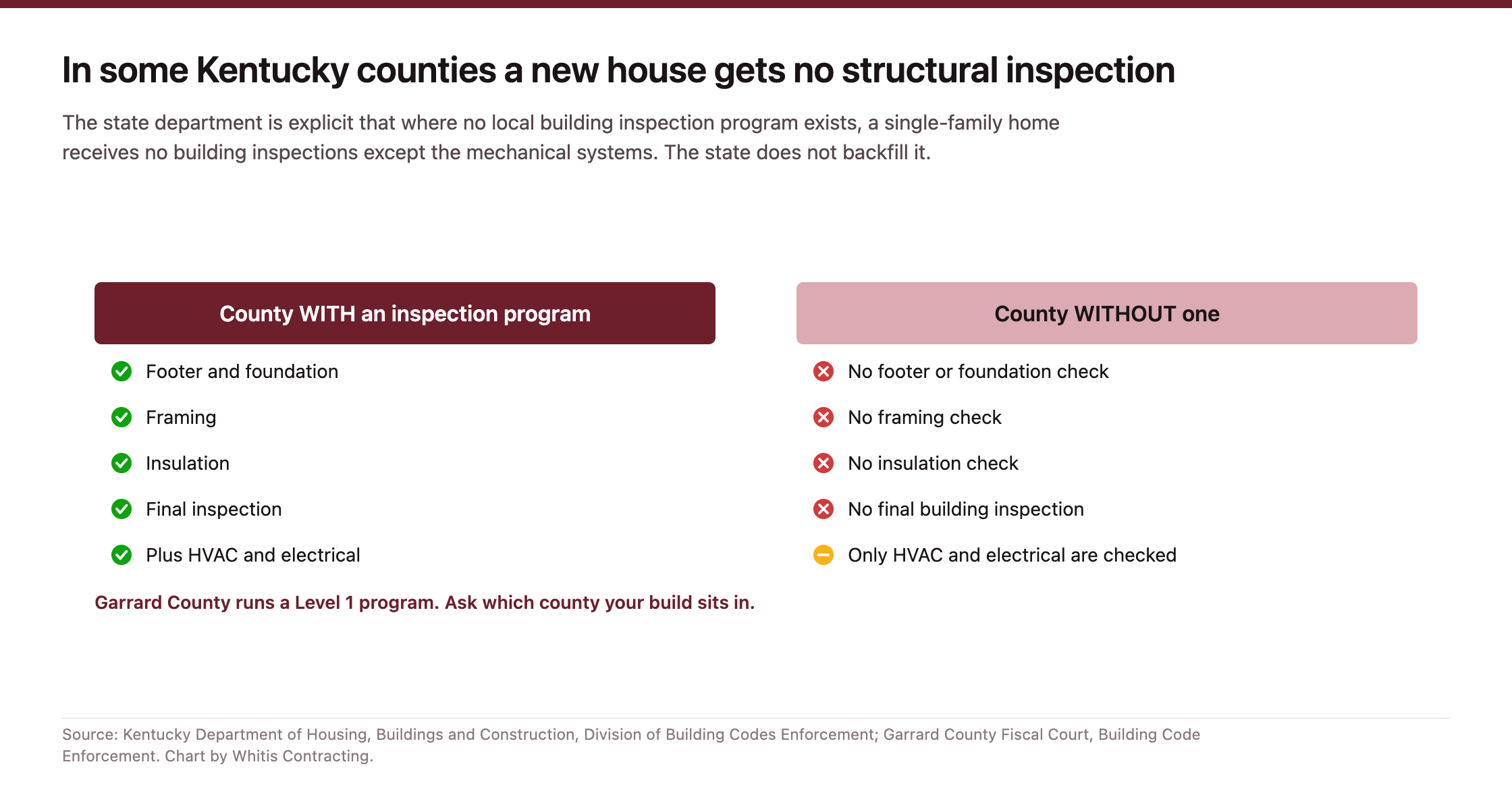
Garrard County does run a program, approved as Level 1 with the state department, with inspections at footer and foundation, framing, insulation and final. Fayette, Boyle and Madison run their own. But the county line genuinely changes what oversight your build receives, and it is a fair question to ask before you choose a site.
The code itself is the Kentucky Residential Code, adopted at 815 KAR 7:125. The current edition is the 2018 Kentucky Residential Code, Third Edition, published in August 2024, which the department states is based on the 2015 International Residential Code with Kentucky amendments. The 2018 in the name and the 2015 underneath it are both correct and are different things.
The lien risk almost nobody explains properly
This is the single largest financial risk in hiring a builder, and it is the one homeowners understand least.
Under KRS 376.010, anyone who performs labour or furnishes materials for work on your property can place a lien on it, and the statute reaches people who worked “by contract with, or by the written consent of, the owner, lessee, contractor, subcontractor, architect, or authorized agent.” A subcontractor or supplier who never had a contract with you, whom you have never met, can lien your land.
The deadlines are specific, and Kentucky treats an owner-occupied home more protectively than other property.
| Step | Deadline | Statute |
|---|---|---|
| Notice to owner, owner-occupied one or two family dwelling | 75 days after last labour or materials | KRS 376.010(5) |
| Notice to owner, other property, claim under $1,000 | 75 days | KRS 376.010(4)(a) |
| Notice to owner, other property, claim of $1,000 or more | 120 days | KRS 376.010(4)(a) |
| File lien statement with the county clerk | 6 months after ceasing work | KRS 376.080 |
| Mail a copy of that statement to the owner | 7 days after filing, or the lien dissolves | KRS 376.080 |
| Bring an action to enforce the lien | 12 months after filing the statement | KRS 376.090 |
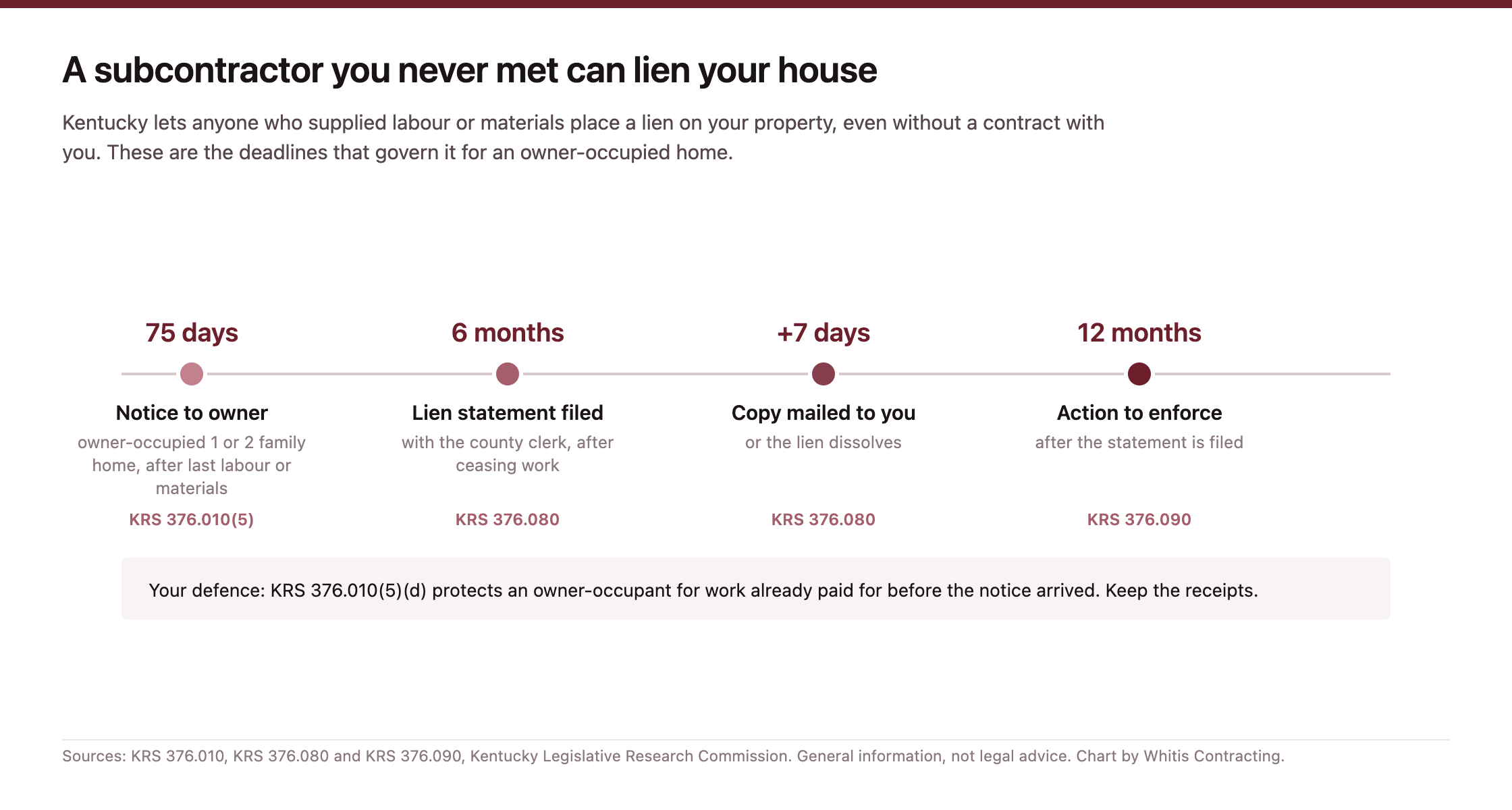
Kentucky does give an owner-occupant a real defence. KRS 376.010(5)(d) provides that the lien does not apply to the extent an owner-occupant has already paid the contractor for that work before receiving the notice. It is a genuine protection, and it turns entirely on timing and on being able to prove what you paid and when. It does nothing for money you had not yet paid out when the notice landed.
Which is what lien waivers are for. KRS 376.070 requires a contractor to apply payments received to the people who furnished labour and materials, and subsection (3) recognises that suppliers and subcontractors can waive lien rights in writing. Worth being precise here: Kentucky statute recognises a written waiver, but the familiar categories of conditional, unconditional, partial and final waiver are contract practice rather than Kentucky statutory definitions. A conditional waiver takes effect only when the payment actually clears. An unconditional one takes effect on signature whether it clears or not. Know which you are being handed.
The Kentucky Attorney General’s guidance says the contract should contain “a pledge that materials be free of all liens by suppliers,” and recommends verifying that subcontractors have been paid before you release final payment.
Which contract structure are you actually signing?
Three structures cover almost everything, and they differ in one respect that matters: who absorbs the cost of an overrun.
The Federal Acquisition Regulation, which governs federal contracting and is the clearest published description of these structures, says a firm-fixed-price contract “provides for a price that is not subject to any adjustment on the basis of the contractor’s cost experience in performing the contract” and “places upon the contractor maximum risk and full responsibility for all costs and resulting profit or loss.”
Cost-reimbursement contracts, the cost-plus family, instead “provide for payment of allowable incurred costs,” with an estimated total and a ceiling the contractor may not exceed without approval. The owner absorbs the variation. A guaranteed maximum price puts a ceiling on that exposure.
Time and materials is the loosest. The same regulation is unusually candid about it: a time-and-materials contract “provides no positive profit incentive to the contractor for cost control or labor efficiency.”
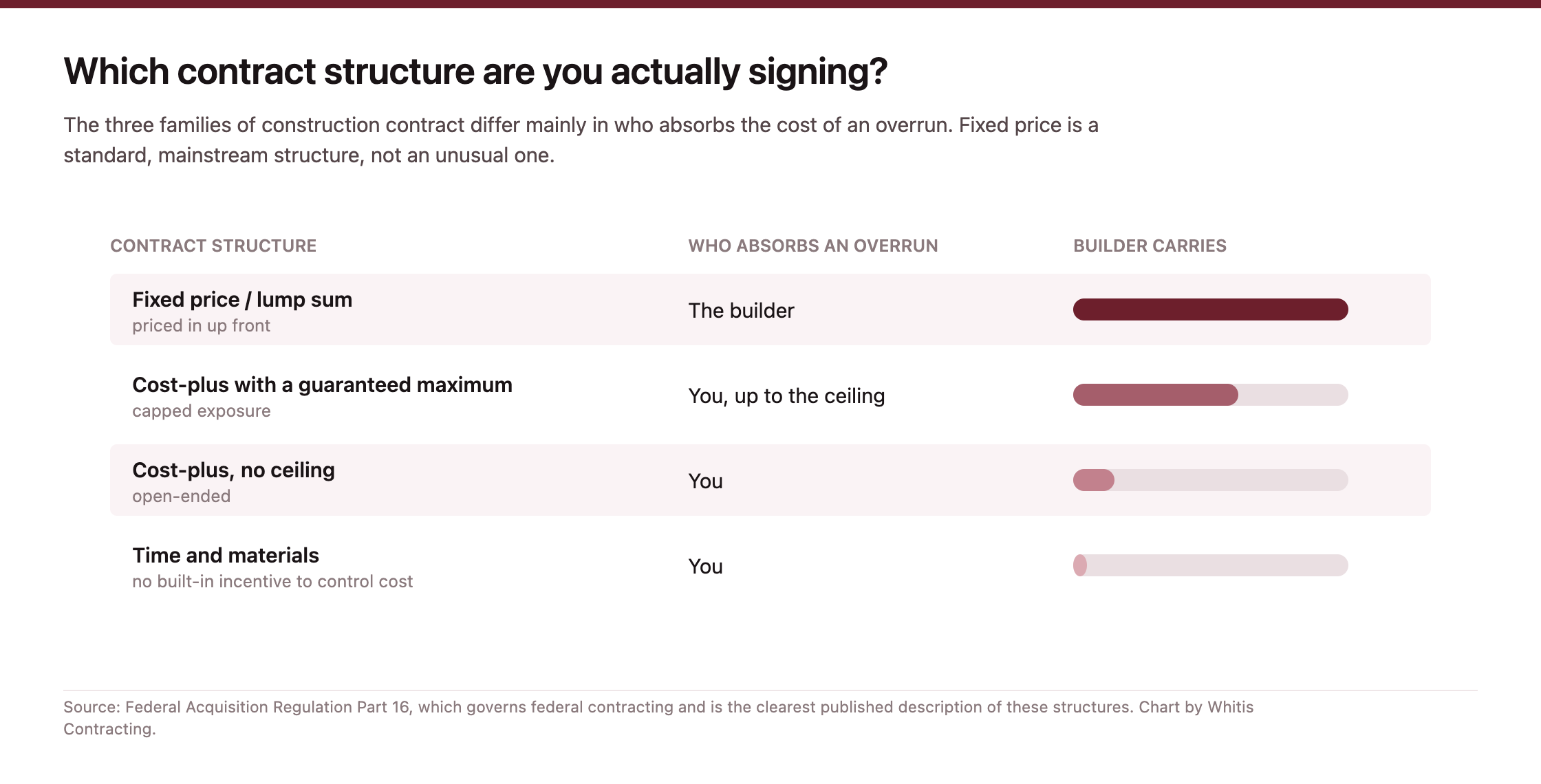
Fixed price is a standard, mainstream structure rather than an unusual one. Some builders work fixed price with no change orders because they would rather settle the number before the work starts than negotiate it during. That is a choice about how a job is run, not evidence that other structures are illegitimate. What matters is that you know which one is in front of you and who is carrying what.
Change orders and the things that must be in writing
Verbal changes are the classic construction dispute, and the fix is structural rather than a matter of trust.
Federal construction contracting solves it with three devices, and a residential contract should carry all three. One named person on each side who can authorise a change. A requirement that the change is written and signed before the work proceeds. And a fixed deadline to price it and claim it: the federal changes clause allows no adjustment for costs incurred more than 20 days before written notice, and requires the contractor to assert a claim within 30 days.
The Kentucky Attorney General’s checklist calls for a “requirement for written approval of plan changes.” The Federal Trade Commission says to write down “any promises made during conversations or calls,” warning that “If they don’t remember, you may be out of luck, or charged extra.”
Your change order clause should say who can authorise, that it must be written and signed first, how the price adjustment is calculated, how many days it adds to the schedule, and what it does to the payment schedule.
Payments and deposits
The Federal Trade Commission’s advice is direct: do not pay the full amount up front, and treat a demand for full payment upfront or cash only as a warning sign. The Kentucky Attorney General says to avoid “sizable deposits or advance payments,” to tie payments to the percentage of work completed, and to withhold final payment until you are satisfied and inspection is complete.
A note on what Kentucky law does and does not do here. Kentucky has no general statutory cap on deposits for ordinary residential construction. There is one narrow prohibition, at KRS 367.626, barring advance payments during the cancellation period, and it applies only to contracts expected to be paid from property or casualty insurance proceeds, which is storm damage work rather than a standard build. Do not assume a statutory deposit limit protects you, because on an ordinary build it does not.
If you are financing through a construction loan, payments come as a series of advances rather than a lump sum, and the Consumer Financial Protection Bureau treats construction lending as its own disclosure category, separate from a standard purchase mortgage.
When you can cancel, and when you cannot
Most people believe they always get three days to change their mind. They do not, and the reason is where the contract was signed.
The Federal Trade Commission’s Cooling-Off Rule turns on a door-to-door test: the sale must be solicited by the seller and the agreement made “at a place other than the place of business of the seller.” Sign in your kitchen, at a fair, at a hotel or at your workplace, and it applies. Sign at the builder’s own permanent office and there is no three-day right at all. Buyer-initiated repairs and genuine emergency repairs are separately carved out.
Kentucky has its own version. KRS 367.410 defines a home solicitation sale as one where the seller personally solicits at a residence of the buyer, and it covers services, not just goods. KRS 367.420 gives the buyer until midnight of the third business day to cancel, extended to the tenth business day for a loan secured by the buyer’s principal dwelling, and says cancellation “need not take a particular form and is sufficient if it indicates by any form of written expression the intention of the buyer not to be bound.”
The detail worth knowing is in KRS 367.430(3): until the seller has given the required written cancellation notice, the buyer may cancel “in any manner and by any means.” The clock does not start until the seller does their part.
Warranties: what Kentucky actually gives you
Kentucky has no statute creating a new home warranty. What exists is a judicial doctrine, going back to Crawley v. Terhune in 1969, in which the Kentucky court held that in the sale of a new dwelling by the builder there is an implied warranty that “in its major structural features the dwelling was constructed in a workmanlike manner and using suitable materials.”
Note the limit. Major structural features. It is not a general guarantee that everything in the house is right, which is precisely why the written warranty in your contract is the document that matters.
For a benchmark, the federal warranty form used for FHA new construction commits the builder for one year against “defects in equipment, material, or workmanship” and states expressly that it is in addition to, not in place of, the buyer’s other rights. The Federal Trade Commission describes the common market structure as one year on workmanship and materials, two years on HVAC, plumbing and electrical systems, and up to ten years on major structural defects.
Two Kentucky time limits sit underneath all of this. KRS 413.135 bars an action over a construction deficiency more than seven years after substantial completion, with a narrow extension to eight where the injury occurs in the seventh year. And KRS 413.120 gives only five years on a contract that is not in writing, which is one more reason not to rely on a handshake.
Frequently asked questions
Do home builders have to be licensed in Kentucky?
No. Kentucky does not issue a statewide license for residential general contractors or home builders. The Department of Housing, Buildings and Construction licenses specific trades including electricians, plumbers, HVAC mechanics, boiler and sprinkler contractors, home inspectors and building inspectors, and those licenses can be checked through its public search. Some cities, Louisville among them, license building contractors locally. Ask what license a builder holds and for what.
Can a subcontractor lien my house if I already paid the builder?
Potentially, but Kentucky gives owner-occupants a defence. KRS 376.010 lets subcontractors and suppliers lien the property even without a contract with you. KRS 376.010(5)(d) then provides that the lien does not apply to the extent you had already paid the contractor for that work before the notice reached you. For an owner-occupied one or two family dwelling the notice must come within 75 days of the last labour or materials. Keep proof of what you paid and when, and collect lien waivers at each payment.
How do I check a builder’s workers’ compensation?
The Kentucky Department of Workers’ Claims publishes a free coverage lookup searchable by employer name, city, postal code or FEIN, returning the policy number and carrier. Kentucky requires coverage from the first employee under KRS 342.630. Separately, KRS 342.610(6) requires the local building official to see proof of the builder’s coverage before issuing a permit, which is a reason the builder rather than you should be pulling it.
Do I always get three days to cancel?
No, and this is the common misunderstanding. Both the Federal Trade Commission’s Cooling-Off Rule and Kentucky’s home solicitation statute at KRS 367.410 turn on the contract being solicited and signed away from the seller’s place of business, typically at your home. A contract signed at the builder’s office generally carries no automatic cancellation right. Under KRS 367.430 the cancellation clock does not begin until the seller has given you the required written notice of the right.
Should the builder or I pull the building permit?
The builder. The Federal Trade Commission treats a contractor asking the homeowner to obtain permits as a warning sign, and the Kentucky Attorney General lists permit responsibility as a contract term. In Kentucky there is an added reason: KRS 342.610(6) makes the permit counter the point where the builder’s workers’ compensation coverage is verified, and that check is aimed at the builder.
Before you sign
Run the three lookups. Read the change order clause and the warranty. Count the allowances. Ask which county inspects the build and what structure the contract is written on. None of that takes long, and it is the difference between trusting a handshake and knowing what you have agreed to.
Whitis Contracting is a family-owned, insured builder based in Lancaster, working across Central Kentucky including Lancaster, Danville, Richmond, Harrodsburg, Lexington, Georgetown and Paris. We are happy to be asked all of the above. You can look at our custom home building, additions and remodels, framing, excavation and site work, land clearing and pole barns, see the portfolio or the people behind it, and get in touch.
This article is general information about Kentucky law and construction contracts, not legal advice. Statutes change and individual situations differ. For a contract with significant money attached, have an attorney review it.
Sources
- Kentucky Department of Housing, Buildings and Construction
- Kentucky DHBC, Division of Building Codes Enforcement
- Kentucky DHBC, License Search and Verification
- KRS Chapter 198B, Kentucky Building Code
- KRS 227A.060, electrical contractor licensing and insurance
- KRS 342.610, contractor liability and proof of coverage for permits
- Kentucky Department of Workers’ Claims, Coverage Lookup
- KRS 376.010, mechanic’s and materialman’s liens
- KRS 376.080, filing the lien statement
- KRS 376.090, limitation on action to enforce a lien
- KRS 376.070, application of payments and lien waiver
- KRS 367.410, home solicitation sale defined
- KRS 367.420, buyer’s right to cancel
- KRS 367.430, notice of the right to cancel
- KRS 413.135, statute of repose for construction
- KRS 413.120, five-year limitation
- 815 KAR 7:125, Kentucky Residential Code
- Kentucky Secretary of State, Business Entity Search
- Kentucky Department of Insurance, Insurer Directory Search
- Kentucky Office of the Attorney General, Home Repair and Improvement
- Federal Trade Commission, How To Avoid a Home Improvement Scam
- Federal Trade Commission, Hiring a Contractor
- 16 CFR Part 429, FTC Cooling-Off Rule
- Federal Acquisition Regulation Part 16, contract types
- FAR 52.243-4, Changes clause for construction
- Crawley v. Terhune, 437 S.W.2d 743 (Ky. 1969)
- HUD Form 92544, Warranty of Completion of Construction
- Federal Trade Commission, Warranties for New Homes