
A production builder builds on its own land and sells you the finished house and lot in one transaction. A custom builder builds on land you already own, under a construction contract. Those are not marketing labels. They are the federal government’s own categories, and almost everything else that differs between the two follows from that one distinction.
Most people comparing builders are really comparing two different transactions without knowing it. The brochures look similar. The process, the timeline, the contract and the amount of the house the builder’s own people actually touch are not.
Here is what genuinely differs, using the categories the US Census Bureau uses to count new houses.
The three paths have official definitions
The US Census Bureau’s Survey of Construction classifies every new single-family house in the country by what it calls purpose of construction. Three of those categories matter to a homeowner.
Built for sale, which is what most people mean by a production or spec builder, is defined by the Census Bureau as “All houses built on builder’s land with the intention of selling the house and land in one transaction.”
Contractor-built is defined as “All houses built for owner occupancy on the owner’s land with construction under the supervision of a single general contractor.” That is the custom path.
Owner-built is defined as “Houses built for owner occupancy, on the owner’s land, under the supervision of the owner acting as the general contractor.” That is you running the job yourself.
Read the first two definitions again and notice what separates them. It is not size, price bracket or finish level. It is whose land the house is built on, and whether you are buying a property or commissioning work.
How many people actually take each path
The Census Bureau and the Department of Housing and Urban Development publish completions by category every quarter. In 2025, of 1,005,000 single-family homes completed in the United States, 721,000 were built for sale, 130,000 were contractor-built, and 50,000 were owner-built.
In the South region, which is where Kentucky sits for Census reporting, 584,000 single-family homes were completed in 2025: 430,000 built for sale, 68,000 contractor-built and 23,000 owner-built.
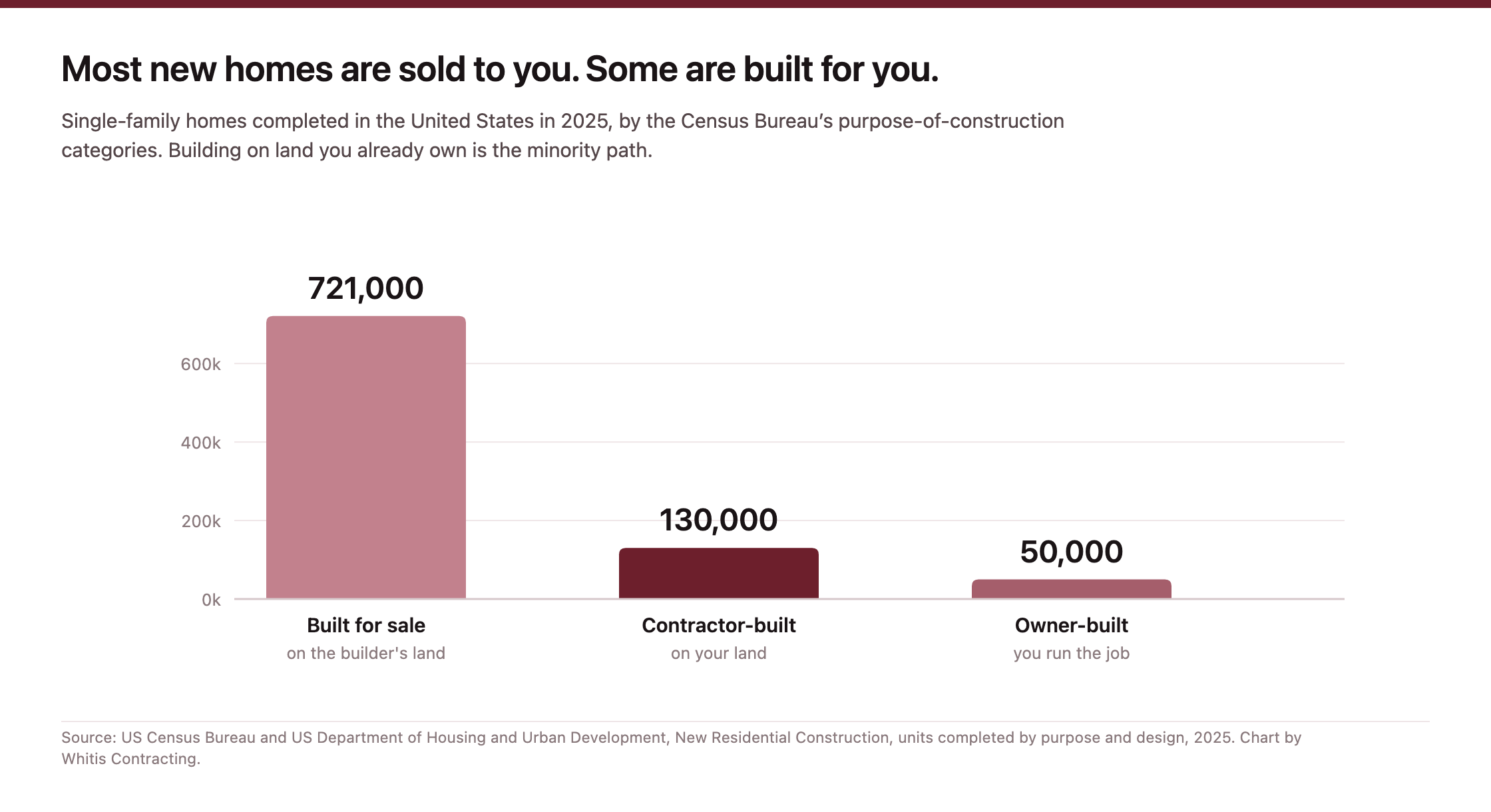
So roughly three out of four new homes in the South are built on a builder’s land and sold as a package. Building on your own land is the minority path. That is worth knowing before you assume the custom route is the default and everyone else is doing something unusual.
The National Association of Home Builders, which combines contractor-built and owner-built into a single custom home building category, reported that custom homes were 17.5 percent of all new single-family homes started in 2024, down from 18.8 percent in 2023 and 20.4 percent in 2022. On its more recent one-year moving average the association puts the share at almost 20 percent of single-family starts.
Who owns the land, and why that changes everything downstream
This is the part that surprises people. In the built-for-sale model the builder holds the land and carries the risk during construction, then transfers house and lot to you together. In the contractor-built model you already hold the lot, and the builder is working under a construction contract on property you own.
The National Association of Home Builders describes the custom category as “home construction undertaken on a contract basis for which the builder does not hold tax basis in the structure during construction.” That is a precise way of saying the asset is yours the whole way through.
Three practical consequences follow. Your financing is a construction loan rather than a straightforward purchase mortgage, and the Consumer Financial Protection Bureau notes that construction loan funds are “typically provided in a series of advances as the construction progresses.” Your legal exposure during the build is different, because liens attach to land you own. And your ability to change things mid-build is a contract question rather than a question of what options the builder still has open.
If you have not bought the lot yet, that decision comes first, and it constrains the house. Slope, access, soil, septic and utilities all shape what can be built and what the excavation and site work will involve before a foundation is poured.
How much of your house the builder’s own people actually touch
Nobody builds an entire house with their own employees. But the share varies enormously, and it varies with builder size in a direction most buyers do not expect.
The National Association of Home Builders surveyed 354 builders in March 2020 and found that the average share of construction costs subcontracted was 84 percent, and that the average home used 24 different subcontractors, with a median of 22.
Then the finding that actually matters when you are choosing between a large builder and a small one. From the same study: “Builders with at least 100 starts on average subcontract 92 percent of the construction work, compared to 84 percent for builders with 25-99 starts.”
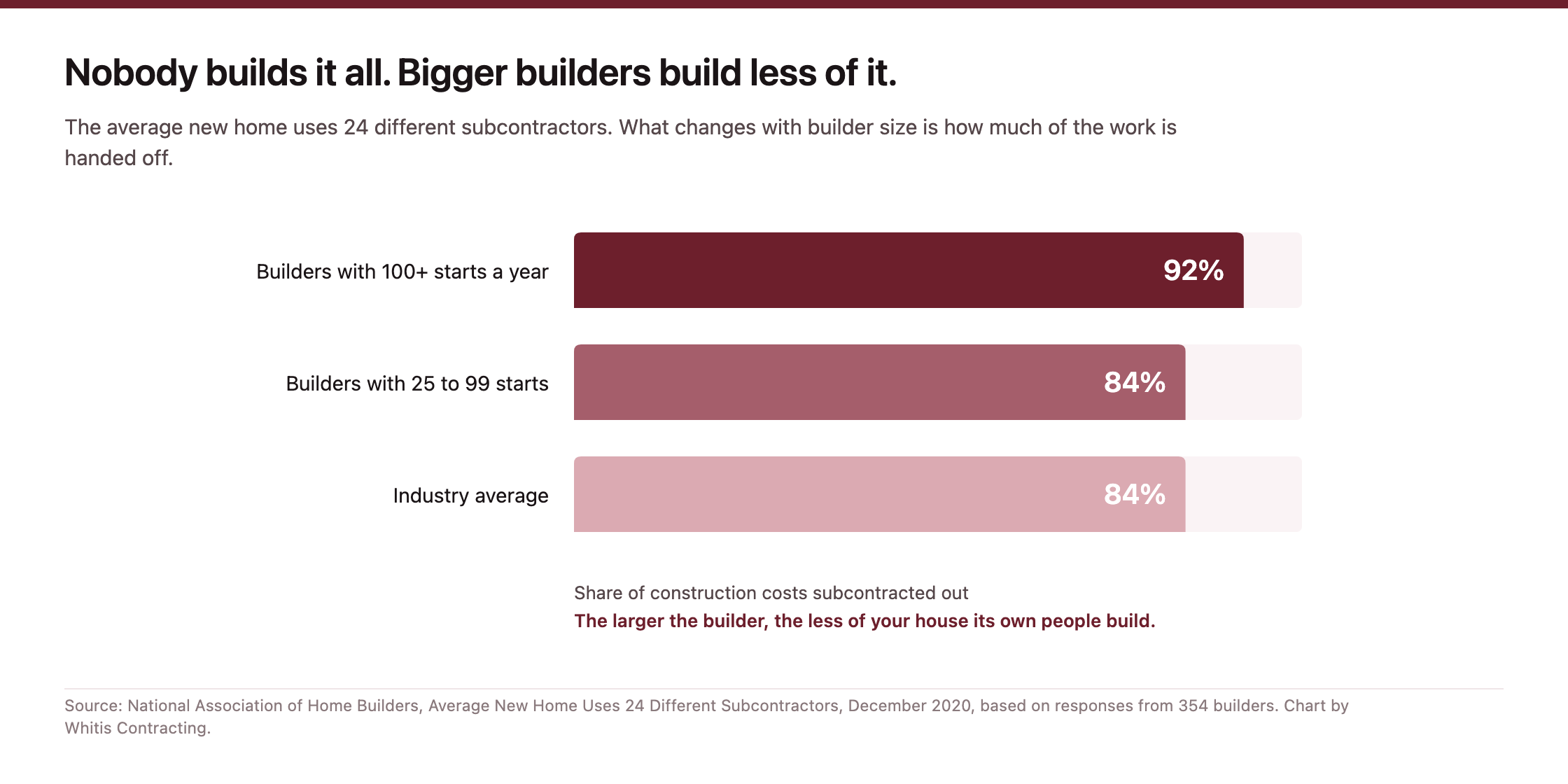
The bigger the builder, the less of your house that builder’s own people build. At high volume a homebuilding company is largely a purchasing and scheduling operation coordinating trades. That is not a criticism, it is how you achieve throughput. But it is a real difference in who is standing on your job.
The same study breaks it down by trade. Ninety-seven percent of builders always subcontract HVAC. Ninety-six percent always subcontract electrical wiring and plumbing. Eighty-two percent always subcontract framing. The lowest rate of all twenty-three trades surveyed was finished carpentry, at 69 percent.
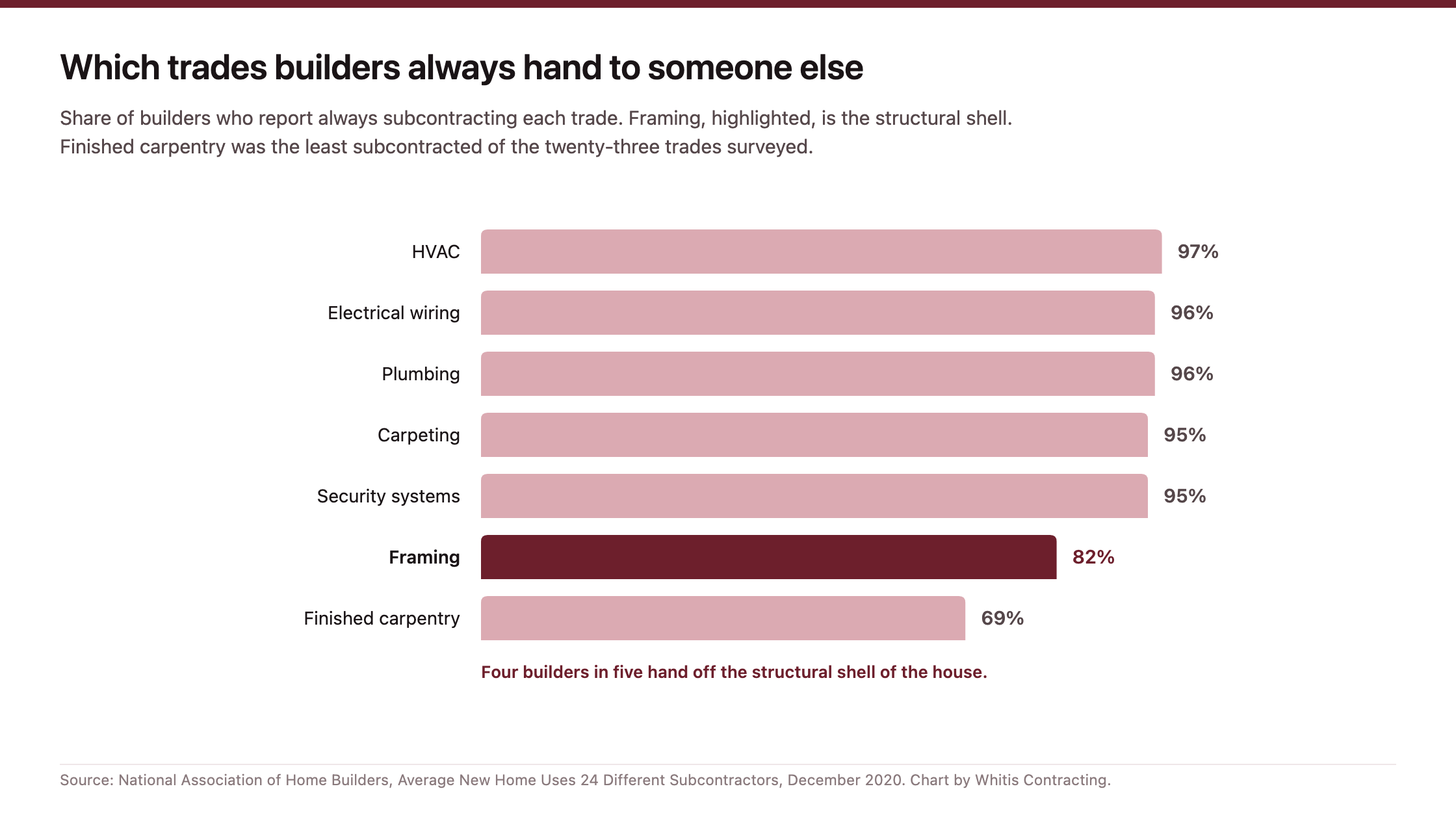
Framing at 82 percent is the number to hold on to. It means roughly four builders in five hand off the structural shell of your house to a crew they do not employ.
That gap is the difference the numbers above are describing. A builder who keeps framing and land clearing on its own payroll controls the schedule and the standard on those trades directly, rather than coordinating them from a phone. It is a fair question to ask any builder you are considering, and the answer tells you a great deal about how the job will actually run.
Timeline: the custom path takes longer, and that is the honest trade
Anyone who tells you a custom home takes the same time as a spec home is not being straight with you.
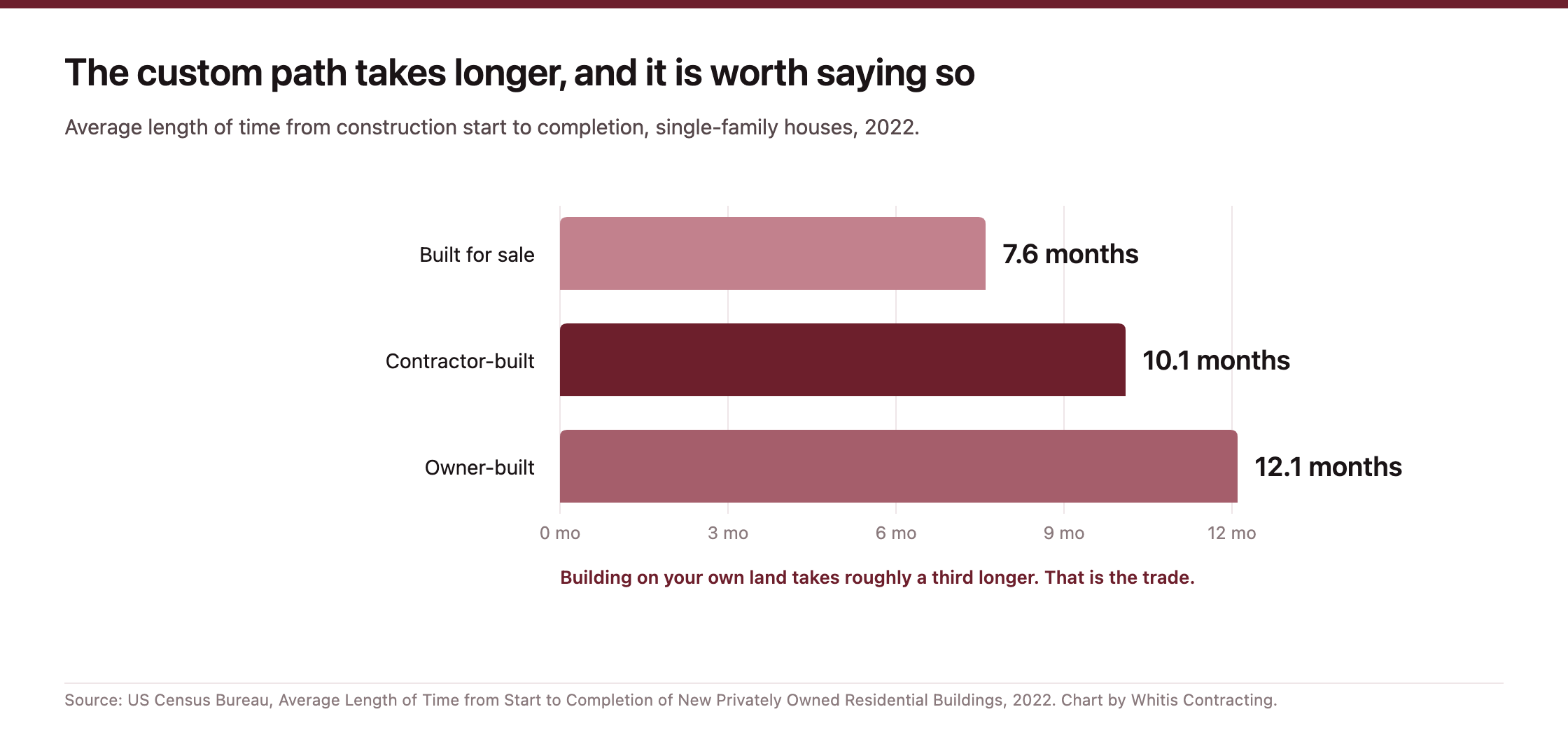
Census Bureau data on average length of time from start to completion, for 2022, shows single-family houses built for sale averaging 7.6 months, contractor-built houses averaging 10.1 months, and owner-built houses averaging 12.1 months.
Measured on a different clock, from building permit authorization rather than construction start, the National Association of Home Builders reported that in 2024 homes built for sale took 7.6 months, homes built by hired contractors took about 12 months, and owner-built homes took 15.1 months. The two measurements are not interchangeable, but they point the same way.
Contractor-built runs roughly a third to a half longer than built for sale. You are paying for that time in decisions: a plan drawn for your lot, selections chosen rather than picked from packages, and changes that are possible because nothing was pre-ordered in bulk. Whether that trade is worth it is a genuine question, and the honest answer depends on how much you care about the specifics.
Design and selections: where the process really diverges
A production builder works from a plan library with option packages, and there is a cutoff date after which the house is committed. That is what makes the schedule predictable. A custom build starts from your lot and your requirements, and the plan is drawn rather than chosen.
Selections are the practical version of this difference. The Federal Trade Commission’s guidance on hiring a contractor says a written contract should contain “a detailed list of all materials including each product’s color, model, size, and brand.” Where a selection has not been made yet, the contract carries a budget allowance instead, and the FTC names allowances directly. Anyone who has been surprised by a final invoice has usually been surprised by an allowance.
This is worth being blunt about: a long list of allowances is a number that has not been decided yet. Ask how many there are and what happens when a selection lands above the allowance. The better arrangement is one where those choices get made in front of you, early, rather than settled later by an invoice.
On what buyers actually want, the National Association of Home Builders surveyed over 3,000 recent and prospective home buyers and found the most wanted features are practical rather than showy: a laundry room and a patio at 86 percent each, ENERGY STAR windows at 83 percent, exterior lighting at 82 percent, and a walk-in pantry, hardwood on the main level and a full bath on the main level all at 80 percent or above. The association also found most buyers across every generation would accept a smaller home in exchange for higher-quality finishes.
The contract and the warranty are different instruments
Buying a finished house is a real estate transaction. Commissioning one is a construction contract, and it should read like one.
The Federal Trade Commission’s contract checklist covers the ground: an estimated start and completion date, the payment schedule for the contractor and subcontractors and suppliers, the contractor’s obligation to obtain permits, written authorization for any change affecting cost or schedule, the materials list described above, and warranty information naming who honours it and for how long. The FTC also warns to get “any promises made during conversations or calls” in writing, because “If they don’t remember, you may be out of luck, or charged extra.”
On warranties, the Federal Trade Commission describes the standard structure as one year covering workmanship and materials on most components, two years covering HVAC, plumbing and electrical systems, and up to ten years for major structural defects. The Department of Housing and Urban Development, which sets requirements for warranty plans it accepts, defines a structural defect narrowly as “actual physical damage to the designated load-bearing portions of a home.”
That narrow definition is the useful part. A ten-year warranty is not a decade of covering everything. It covers load-bearing failure. Read what the other nine years and eleven months actually promise.
Contract structure differs too. A fixed-price contract is an industry-standard arrangement, not an exotic one, and it means the builder prices the risk of an overrun in exchange for carrying it. It suits people who want the number settled up front. It is a structure with a trade-off, not a magic trick, and you should understand which structure you are signing either way.
Which one actually fits you
A production builder is the better answer if you want a known move-in date, you do not own land, you are content choosing from packages, and speed matters more than specificity. That is a completely reasonable set of priorities and roughly three quarters of buyers in the South choose it.
A custom builder is the better answer if you already own a lot or have a specific piece of ground in mind, the house has to solve something a plan library does not, you want to know who is physically on your job, and you can live with a timeline measured in a third longer.
If you are somewhere between the two, the lot usually decides it. A difficult site is a poor match for a plan drawn for a flat subdivision lot.
Frequently asked questions
What does contractor-built actually mean?
It is a US Census Bureau classification, defined as houses “built for owner occupancy on the owner’s land with construction under the supervision of a single general contractor.” In plain terms: you own the lot, one builder runs the job, and the house is yours throughout rather than bought at the end. In 2025 there were 130,000 contractor-built single-family completions nationally and 68,000 in the South.
Do custom builders use subcontractors too?
Yes, and any builder claiming otherwise is overselling. National Association of Home Builders research puts the average share of construction costs subcontracted at 84 percent across the industry. The meaningful question is which parts are kept in house. The same study found that builders doing 100 or more homes a year subcontract 92 percent, against 84 percent for builders doing 25 to 99. Framing is the clearest test: 82 percent of builders always hand it off, so a builder who keeps it on its own crews is doing something most of the industry does not.
How much longer does a custom home take?
Census Bureau figures for 2022 put built-for-sale houses at an average 7.6 months from start to completion and contractor-built houses at 10.1 months. On a permit-to-completion basis, the National Association of Home Builders reported 7.6 months versus about 12 months for 2024. Either way, expect roughly a third to a half longer, and treat any promise otherwise with suspicion.
Do I need to own the land before I start?
For the contractor-built path, yes, by definition. Both Census categories for building on your own land say exactly that. In practice the lot comes first because it constrains the plan, the foundation and the site work. If you are still looking, get the ground assessed before you commit to a design.
What is an allowance, and why does it matter?
An allowance is a budget placeholder for a selection you have not made yet, and the Federal Trade Commission names them in its contractor guidance alongside the requirement for a detailed materials list specifying colour, model, size and brand. Allowances are where budgets move after signing. Ask how many the contract contains and what happens when a real selection comes in above the number.
Talking it through
If you own a piece of ground in Central Kentucky, or you are looking at one, the useful next conversation is about the site rather than the house. What it will take to get it ready usually decides what is sensible to build on it.
Whitis Contracting is a family-owned, insured builder based in Lancaster that keeps framing and site work on its own crews, working across Central Kentucky, including Lancaster, Danville, Richmond, Harrodsburg, Lexington, Georgetown and Paris. You can see our custom home building work, browse the portfolio, read more about the family behind it, look at the full range of services including additions and remodels and pole barns, or get in touch to talk about a site.
Sources
- US Census Bureau, Survey of Construction: Definitions
- US Census Bureau and HUD, New Residential Construction: units completed by purpose and design
- US Census Bureau, Average Length of Time from Start to Completion of New Residential Buildings
- National Association of Home Builders, Average New Home Uses 24 Different Subcontractors (2020)
- National Association of Home Builders, Single-Family Homes Are Built Faster in 2024
- National Association of Home Builders, Custom Home Building Share Declines in 2024
- National Association of Home Builders, Custom Home Building Expanded in 2025
- National Association of Home Builders, Most Wanted Home Features
- Federal Trade Commission, Hiring a Contractor
- Federal Trade Commission, Warranties for New Homes
- US Department of Housing and Urban Development, Handbook 4145.1 Chapter 6, Insured Ten-Year Protection Plan
- Consumer Financial Protection Bureau, What is a construction loan?